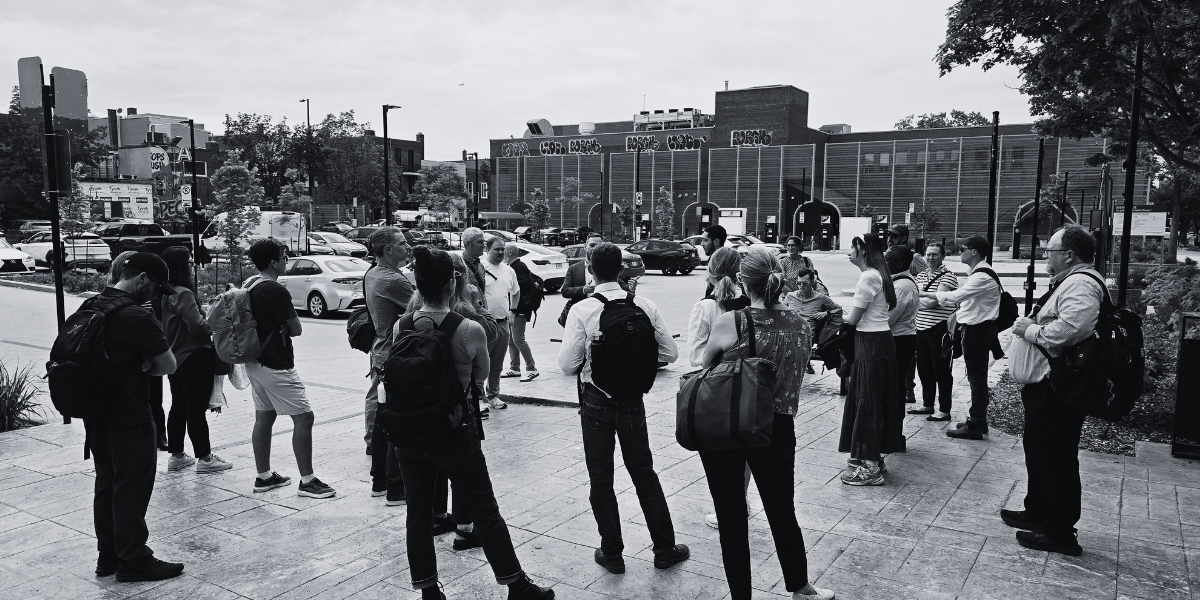
This June, the OMF’s Smart Curb Collaborative, comprised of 15 cities from Europe, Canada and the US, convened in Montréal for a packed two days of learning and activities. Hosted at the offices of the Agence de Mobilite Durable, a key highlight of the convening was learning more about the agency, its mission, and a key initiative: Montréal’s mobility hubs.
Collaborative participants visited the Boyer Street Mobility Hub to see a real-world example of how cities can rethink underutilized public space, curb space and parking assets to support a broader vision for mobility, climate resilience, and vibrant public spaces.
The visit brought many of the themes discussed throughout the two-day convening to life. While much of the Collaborative’s work focuses on digital curb management, curb regulations, and data standards, the mobility hub demonstrated how those tools can ultimately support physical places that better serve people and communities.
From Parking Lot to Mobility Hub
Located in Montreal’s Rosemont–La Petite-Patrie neighborhood, the Boyer Street Mobility Hub transformed what was once an underutilized surface parking lot into a community asset and a neighborhood mobility destination. Rather than serving a single transportation mode, the site brings together a variety of mobility options and public amenities in one integrated public space.
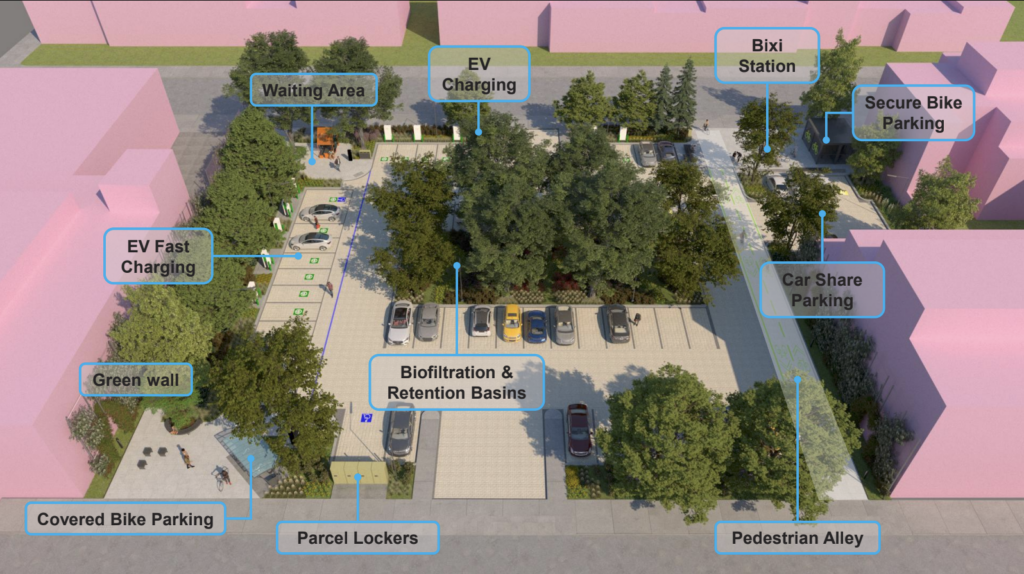
A rendering of the vision for a complete Mobility Hub, courtesy of L’Agence de mobilité durable de Montréal
Montréal’s mobility hub vision includes:
- Shared mobility services, including facilities for bike sharing and car sharing
- Secure bicycle and cargo bike parking
- Level 2 and fast electric vehicle charging
- Paid parking that continues to serve neighborhood needs
- Safer pedestrian crossings and improved accessibility
- Parklets and public gathering spaces
- Green infrastructure, including trees, landscaping, permeable pavement, and underground stormwater retention that help reduce urban heat islands and manage rainwater.
Together, these elements create a space that supports residents and local businesses with many different ways of moving to and through the neighborhood while making the public realm more welcoming and resilient.
A Living Example of Integrated Curb Management
For members of the Curb Collaborative, the visit underscored an important lesson: effective curb management extends far beyond regulating parking or loading.
Throughout the convening, participants explored how digital curb management tools like the Curb Data Specification (CDS) and Mobility Data Specification (MDS) can help cities manage increasingly dynamic curb space. Montréal’s mobility hubs were a great real-world example of a space that could be digitally represented by different zones, policies, and events. After our visit, OMF’s Director of Open Source Operations, Michael Schnuerle, even created a mockup of a CDS overlay at the Boyer Street Mobility Hub:
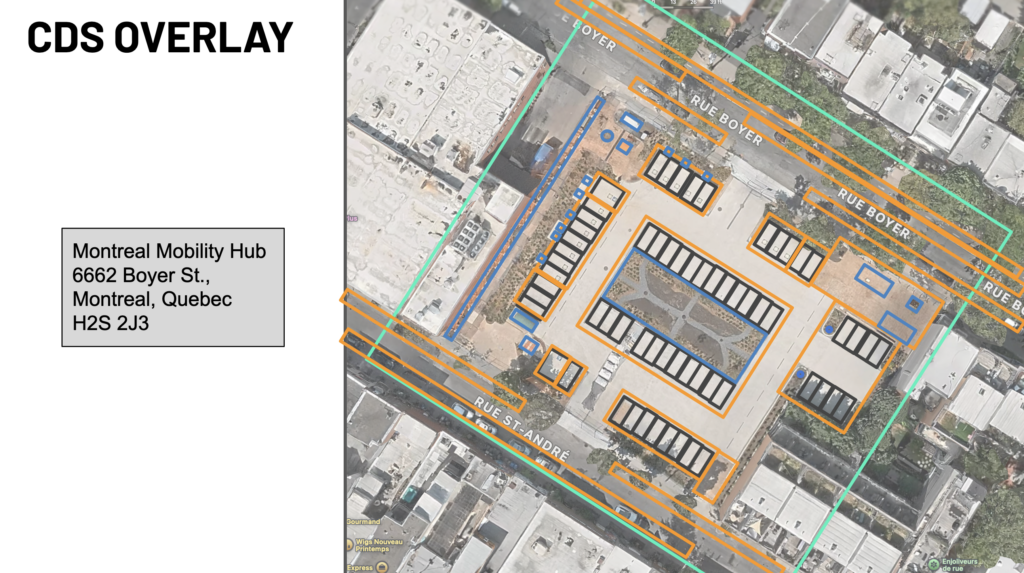
As cities introduce EV charging, shared mobility, bike parking, loading zones, accessible spaces, and green infrastructure, the curb becomes an integrated system that requires coordination across multiple agencies and operators. CDS and MDS are key tools to digitally manage public space.
This integrated approach reflects a broader shift in how cities are thinking about curb space — not simply as infrastructure for moving and storing vehicles, but as valuable public space that can deliver environmental, economic, and social benefits simultaneously.


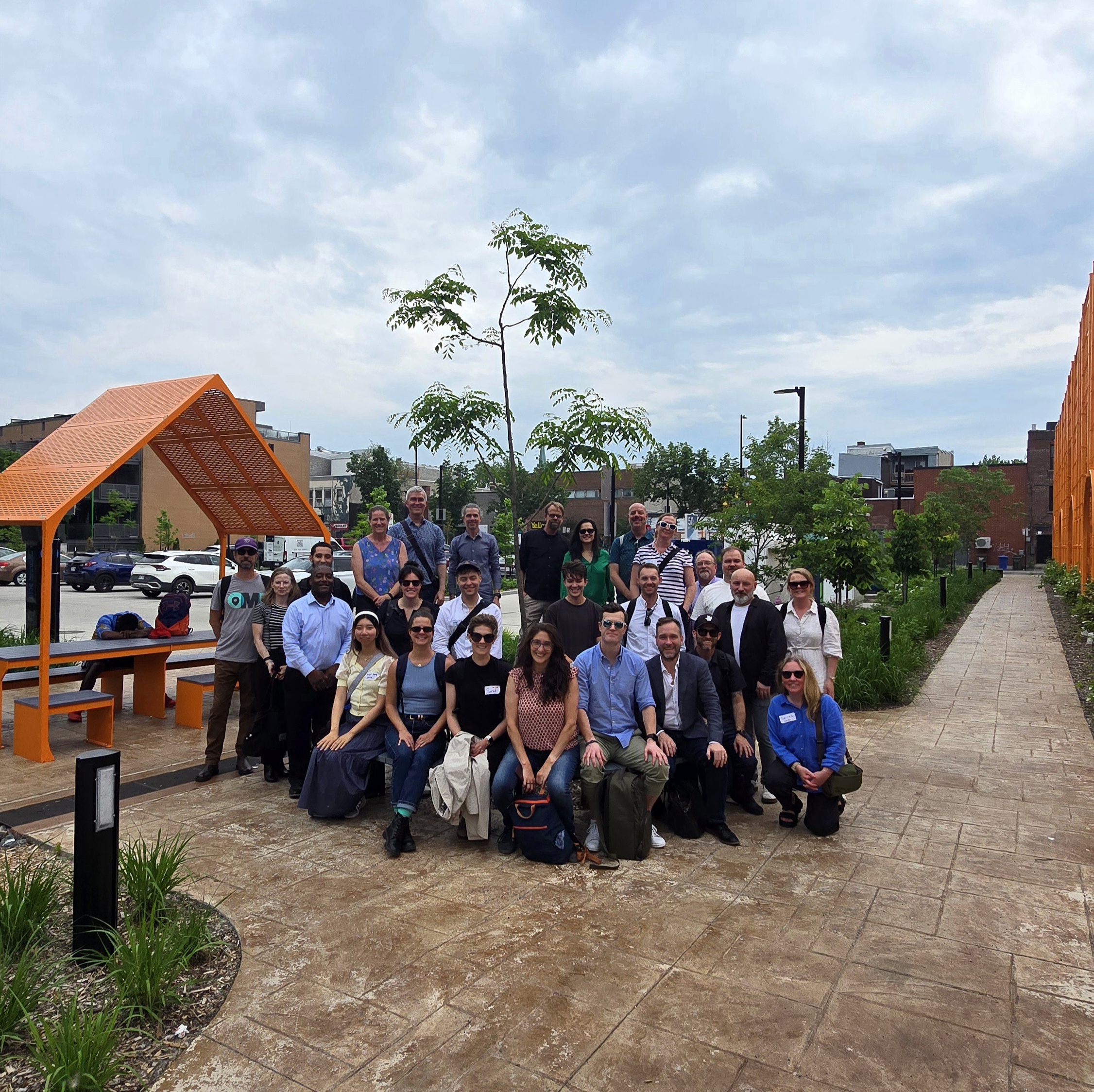
Learning from Montreal
Site visits like this are one of the most valuable parts of the Curb Collaborative. They provide an opportunity to see innovative ideas in practice, ask questions of local practitioners, and connect technical discussions with real-world implementation.
The Open Mobility Foundation is grateful to the Agence de Mobilité Durable de Montréal for hosting the visit and sharing the vision, planning, and partnerships behind their mobility hubs. Seeing the project firsthand gave participants a tangible example of how public space digitization, thoughtful curb management, sustainable mobility, and placemaking can come together to create more connected and resilient cities.
To learn more about the OMF’s work, consider becoming a member to gain access to OMF Academy courses. Follow our calendar for upcoming events.
This is the first in a three-part series about the Read more
Technology and data offer new tools to proactively manage curbs Read more
The 1.1.0 release adds new top level APIs, privacy options, Read more